We come together to play music; we play music to come together…

I am in the process of compiling a short bio on each of our musicians. In her bio, McLaren Davies sums up her experience with the Venice Community Orchestra by the following sentence – We come together to play music; we play music to come together. To say the least, I am captivated by her thoughtful message.


I think that McLaren captured the essence of our purpose and summed it up very nicely. From now on, I will use this sentence as a tag line for the VCO to better convey who we are. I’d love to hear my fellow musicians reaction to this post.
We come together to play music; we play music to come together…2015-05-27T20:58:27+00:00

Our first public performance …

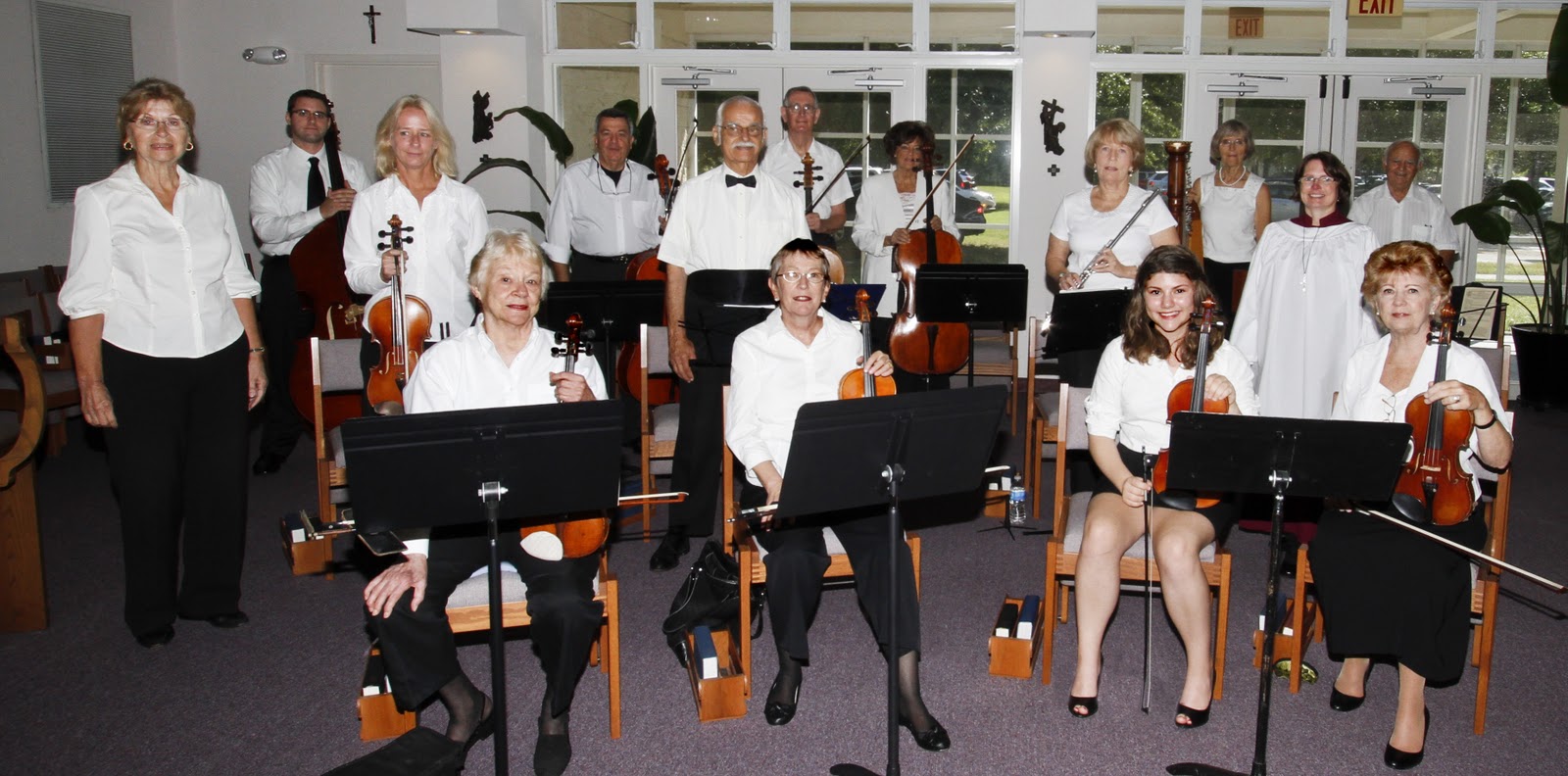
Yesterday was the first time we played in front of an audience. This was a big milestone for us. We took that opportunity to thank Good Shepherd’s parishioners for hosting us during our weekly rehearsals and introduced the orchestra. We played AIR No 11 by Handle. If you want to hear us please click below.

Click here to hear us play

Click on the link above this picture to hear us play Photo by Al Churilla
Our first public performance …2017-04-12T19:21:04+00:00

A visit to Venice High string orchestra

Earlier this week I had the opportunity to visit Venice High school. I attended a string orchestra class led by Ms. Iras Roback their music teacher. Ms. Roback was gracious enough to invite me to hear her 30 students play and take advantage of my visit to promote the VCO. The students were just back from their summer vacation, yet their play was wonderful! I can’t wait to revisit in a few months for one of their concerts.

I thought that the students are very fortunate to have the opportunity to play five days a week with such a great coach! I wished I had the same opportunity!

I brought along and distributed a VCO promo flyer to the entire class and let them know that we would be delighted to welcome VHS musicians on Thursday rehearsals. Hopefully a couple of Ms. Roback’s students will decide to join us soon.

A visit to Venice High string orchestra2015-05-27T20:58:27+00:00

Surprise visit during rehearsal…

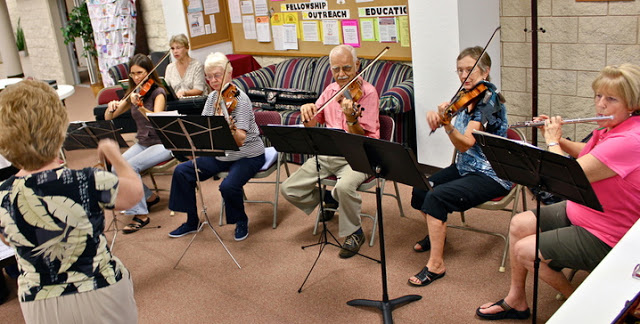
Last week, a photographer from the Herald Tribune surprised us with a visit while we were rehearsing. Click here to see some of the pictures he shot. As always, besides making good music, we’re having a ball!


Photo by Herald Tribune


Surprise visit during rehearsal…2017-04-12T19:21:15+00:00

"Ambassador Program" for students… why?

To put things in perspective, the VCO is about attracting musicians of all levels.  Some local high schools have wonderful music programs and students who might be interested in joining an orchestra. Luckily, with the help of local music teachers, a couple of students have recently joined us.

Recently, we put in place an “Ambassador Program”. It should help attract more students and build a bridge between the schools and the VCO. Most importantly it can put the student in a leadership position in his/her school and help build his/her Resume. To qualify, the student needs to attend three consecutive practice sessions and show an interest in helping the orchestra grow.

Many moons ago, a teenage student’s Resume showed her work experience with an organization keen on attracting other students – the good old days. She also showed on her Resume that thanks to her good work, she was appointed an Ambassador to help her attract more students to that organization.

The following summer, when jobs were much tougher to get – sounds familiar? – her Ambassadorship appointment was discussed during an interview and helped in getting her the job she had hoped for. How do I know that? The name of the student who shared this story with me is Lori Mabardi, my daughter.

"Ambassador Program" for students… why?2015-05-27T20:58:27+00:00

The Venice Community Orchestra “of”, “for” or “at” the Good Shepherd Church?

The difference between “of”, “for” or “at” came to light when we decided to secure ownership of the orchestra’s name by registering it with the Division of Corporations of Florida. Sounds like a trivial question, but it took some reflection before deciding to replace “of” by “at”. Our pause had nothing to do with music, it was all about conveying the correct message.
 
During a recent casual conversation with Fr. Jon, Rector of Good Shepherd, it became clear that the preposition “of”, may unintentionally convey the impression that the orchestra belongs to GS.  As discussed in earlier posts, the orchestra has indeed a special relationship with GS, but it really belongs to the musicians. 

 
Next question was: If not “of” what is the most appropriate preposition? “For” was discussed but quickly dismissed as it conveys an exclusive relationship between VCO and GS. Part of our goal is to build relationships with the Venice community and various local entities while maintaining the special relationship we have with GS; but “for” did not reflect that broader intent. 

 
What about “at” the Good Shepherd? 

 
We are hosted by GS and we practice our music there, it is our homebase. It seemed perfectly logical to conclude that “at” is the better choice among the three prepositions. It rightly conveys that GS is in fact where you can find us practice weekly in Venice. Hence we became “The Venice Community Orchestra” at the Good Shepherd Church, a minute but important name change that will convey the correct message. 

The Venice Community Orchestra “of”, “for” or “at” the Good Shepherd Church?2015-05-27T20:58:27+00:00

I now have a better answer to a question that keeps popping up…

At almost every opportunity I have to describe the orchestra, I am asked the question: What’s the typical experience of musicians joining the VCO? Or, what level of music difficulty do you play; which eventually leads to visiting the membership make-up. My typical answer was something like: Our musician’s experience vary from beginner to professional level player.

Most recently a colleague musician lent me an article on amateurs’ sight reading orchestras written by Dr. Robert Mueller, a music teacher from the University of Arkansas. Muller subdivides the membership of his orchestra in four categories. I took the liberty of tweaking his definition and break it into five categories to better describe our membership. Now I can give a more articulate answer to the question.

Essentially, our members have one of the following profiles:

  • The beginner who can learn by sitting next to better players who pulls them along to a higher level of playing;
  • The invertebrate amateur who simply likes to play;
  • The more mature player who once played well and desire to maintain their skills;
  • The younger musician who aspires to become a pro musician, and;
  • The pro who simply likes to play while helping others in reaching higher levels of playing.

I think that’s a much better description of our membership than the one I used to give.

I now have a better answer to a question that keeps popping up…2015-05-27T20:58:27+00:00

The growing pains of attracting wind instruments talent…

Selecting sheet music to play during our formative phase is not a simple mater. If our objective is to become a “Full” orchestra, the music should include most parts of a full orchestra. Yet I am discovering that wind instrumentalists are rare to find in Venice. I recently consulted with a Florida based well know conductor who confirmed that amateur wind instrumentalists who live in smaller communities tend to join bands rather than orchestras; a fact I can’t ignore.

The music written for a “Full” orchestra will sound thin without flutes, trumpets, trombones, or saxophones. One would think that the obvious solution is to start building the orchestra as a “String orchestra”. Yet, you never know when a brass or woodwind player will call to join you. Without wind parts to show, we will not be able to attract wind instrumentalists.

We are facing a chicken and egg challenge.

A simpler approach to gradually transition from a string to a full orchestra is to build a repertoire based on series of music compilations published in individual booklets for each instrument; typically 8 to 12 pieces of music per booklet.

These series are intended for like or mixed instruments and work for any size group or combination of instruments. They are generally available for strings, brass, woodwinds, and percussion.

The orchestra can start as a smaller ensemble like a string quartet and add parts as new instruments join in. This approach is significantly less onerous than starting with string orchestral pieces to be replaced by full orchestral ones as the group matures and transitions into a full orchestra.

Examples of compilations include:

  • Classical Quartets for All from the Baroque to the 20th Century;
  • Movie Favorites;

  • Broadway Favorites;

  • Movie Quartets for All;

  • Quartets for All;

  • Pop Quartets for All.

The VCO will consider that approach as a way of attracting wind instrumentalists while containing the cost of new music.
The growing pains of attracting wind instruments talent…2015-05-27T20:58:27+00:00
Go to Top